
Ken Follett: Stonehenge goes 1968
Critique of "The Circle of Days"

For once, let us turn to a completely different subject — at least in appearance — and talk about Ken Follett’s brand-new novel “Circle of Days”. Not only is it a truly dreadful book, but it is also marked by an almost comical ideological bias, so transparent and extreme that it borders on parody.
Believe it or not, but I must admit that I quite enjoyed “The Pillars of the Earth”, published in 1989, which I first read when I was still a history student in the late 1990s, like just about all my classmates. Naturally, we shared — as students everywhere probably do — the arrogance of believing that, with our fledgling academic experience, we could have written a novel far closer to historical reality than Follett ever did. And yet, I think that, secretly, this book exerted considerable influence on how we all imagined the Middle Ages. At the time, I was not yet particularly attentive to the ideological biases present in the novels I read, but I already remember noticing that, for a book devoted to a subject that was ultimately deeply religious, it showed remarkably little sensitivity to spiritual matters.
Well, Ken Follett has struck again — and even harder this time. With “The Circle of Days”, the author takes on the construction of one of the oldest and most enigmatic religious monuments on our continent, and yet manages to almost entirely sidestep the spiritual dimension of the era (the middle of the third millennium BCE). At the same time, he nevertheless inserts an idealization of communism, praise of homosexuality, the stereotype of priestly pedophilia, and — of course — a critique of patriarchy. But let us begin at the beginning.
The novel claims to depict the main phase of construction of the Neolithic monument and follows closely the lives of several individuals associated with this project. Chief among them are its brilliant builder — a sort of deconstructed engineer suffering from the violence of his father and brothers — and the high priestess, who possesses no genuine religious convictions (indeed, no one in the novel does) and dreams only of finding the woman of her life (yes) and bequeathing to posterity a monument as imposing as possible.
The world inhabited by these characters is defined by the coexistence of three groups, which also represent three stages of human evolution: forest dwellers, scarcely civilized hunter-gatherers; pastoralists, the true heroes of the story, living in free love and communal harmony; and finally the first farmers, who toil endlessly in a kind of dystopian patriarchal community under the yoke of private property. The author ultimately devotes little attention to the first group, the hunter-gatherers, except to portray them as noble savages — a direct copy-and-paste of Native Americans as depicted in old Western films. The farmers, by contrast, are the true “villains” of the story. They work relentlessly from sunrise to sunset, cling fiercely to their plots of land, produce children incessantly — thereby, of course, disrupting the oh so fragile balance of their ecosystem — and, above all, are organized according to a radically patriarchal system in which women are the property of their fathers or husbands, who continuously rape, beat, and exploit them while being utter stupid brutes. Their entire community is ruled by a “great man” who thinks only of accumulating more goods and wealth, and who is ready, flint in hand, to encroach upon the lives and resources of other communities in order to become the chief of the entire “great plain” where the novel unfolds.
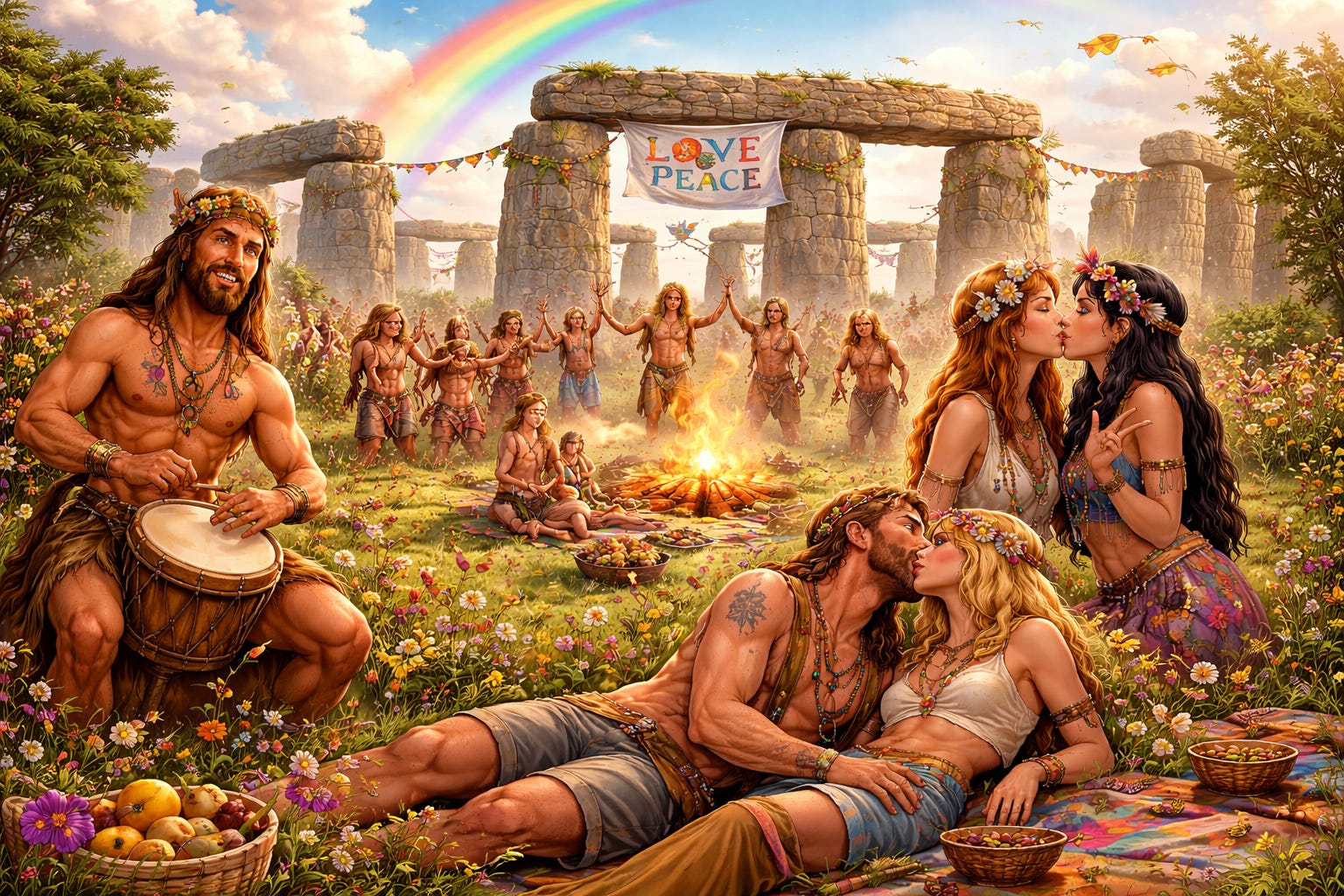
It is therefore the pastoralists who are the real heroes of the story. All property belongs to them collectively; everyone takes what they need when they need it; authority is exercised through friendly arbitration rather than violence, by a small council of elders (men and women in equal measure, needless to say). Free love is widely practiced, and homosexuality is a common custom that no one criticizes — a kind of sexually liberated, anarcho-communist commune à la 1968, or a Neolithic Woodstock, though without guitars or LSD: only flint tools and free love. Why, then, did the agricultural revolution ultimately marginalize the pastoral way of life? Follett offers only one answer — an obviously absurd one: not food security, but toxic masculinity and its violence.
The somewhat obsessive praise of homosexuality reaches its climax in the community of “priestesses” who manage the temple of Stonehenge and live apart from the rest in a small lesbian collective, headed by a “great priestess” who, in the second half of the novel, becomes the true driving force behind the expansion of the megalithic monument.
Though she is ready to manipulate the religious beliefs of her followers, to divert urgently needed labor from elsewhere, and ultimately to risk human lives in order to achieve her aims, Follett nevertheless portrays her as a positive heroine. Yet the true purpose of the construction — or rather the enlargement — of the monument remains strangely vague, given the pervasive agnosticism, or even atheism, of the novel. Aside from a few vague allusions to a “sun god” who might (perhaps, who knows) appreciate a monument erected in his honor, the driving motive is above all the desire to build something that will imprint the priestess’s own mark — and that of her companions — upon the fabric of time and space, as well as her plan to increase the economic popularity of the calendar festivals organized by the pastoral community.
In other words, a purely self-glorifying structure with no higher or transcendent purpose. Indeed, in the world of the “Circle of days”, apart from two legends about the origins of humanity and a handful of vague references to the gods of the sun and the moon, all forms of spirituality are radically absent — which, given Ken Follett’s militant atheism, comes as no surprise.
Certainly, our knowledge of the third millennium BCE remains extremely fragmentary, and any novelist has the right to do what he wishes with his source material in pursuit of his own aims. But the reader likewise has the right not to take seriously an author who so blatantly subordinates historical material to ideology. Opportunities to allude to prehistoric belief systems were abundant — childbirth, sexuality, murder, love, illness, death, burial, and so on — yet the men and women of the novel are as far removed from any spiritual interpretation of these events as the average white, atheist Londoner of today.
Even the priestesses never speak of belief, gods, or the afterlife. According to Follett, their order existed merely to count the days of the year by dancing and singing, in order to announce the changing of the seasons — nothing more. Pure scientists, who invoke the gods only when they wish to manipulate believers. One might argue that, given the lack of documentation on Neolithic spirituality, the author preferred not to indulge in futile speculation. Yet when it comes to the innate wickedness of agricultural patriarchy, the omnipresent tolerance of homosexuality, or the joyful pseudo-communism of the pastoralists, Follett does not hesitate to deploy every stereotype drawn from contemporary woke ideology. The absence of religion is therefore a personal choice, not the result of scholarly restraint.
And most likely, the author was not even aware of it. Proof of this lies in the terribly anachronistic nature of the novel’s dialogues. The characters constantly speak with a thoroughly modern complexity about intrigue, psychology, politics, ecosystems, and introspection — to such an extent that one cannot avoid suspecting that Ken Follett, despite having built his entire career on historical novels, has never truly grasped that the mentality of a man of the past is fundamentally different from that of a modern individual.
One might forgive a few anachronisms in a medieval setting — but certainly not in the Neolithic. Reading the “Iliad” alone suffices to reveal how radically different the speech, thought, and worldview of an eighth-century Greek were. In contrast to the individualistic nihilism of the twenty-first century, the archaic Greek was entirely shaped by belief, custom, instinct, status, and language — the frameworks that constrained the meanderings of a still-emerging individuality. For an author genuinely attempting to convey the spirit of a past age, it would therefore have been essential to reflect the limits of thought and self-development imposed by that era. Follett does not even attempt this, despite the fact that the study of still-existing prehistoric tribal societies might at least have allowed him to approach the problem.
Admittedly, Follett makes an effort to respect the concrete material conditions of Neolithic life and its severely limited technological possibilities in constructing his narrative framework. But since he fills this minimalist setting solely with impulses and thoughts typical of a twenty-first-century atheist Englishman, the result is curiously hollow and rather dull. The text only truly comes to life in the final hundred pages — and then solely because the actual construction of Stonehenge is finally described in concrete terms.
In a paradoxical way, the boredom inspired by this failed epic is not the result of any cultural shock between the Neolithic world and our own. Rather, it arises from the projection of a modern mental framework into the past — one which, stripped of the distractions of modernity, reveals the shocking extent of its own spiritual and emotional emptiness. Thus, after finishing the novel, both the monument of Stonehenge and the inner world of Neolithic humanity remain entirely mysterious. Or rather, the reader acquires one new certainty: the mental universe depicted by Ken Follett is probably the exact opposite of what animated our ancestors five thousand years ago. But let us reassure Follett: his characters would doubtless feel perfectly at home in a Netflix series.
Danke, dass Sie sich die Mühe gemacht haben. Aber lesen werde ich das nicht. Ich bin schon, ohne es zu lesen, entsetzt. Man kann wirklich alles missbrauchen, auch die Idee der ewigen Wiederkehr. Interessant fände ich eine Betrachtung des Neuen unter der Sonne und der geschichtlichen Vorläufer des Seltenen, z.B. von anarchistischen Sonderlingen wie Noam Chomsky. War Pierre Abaillard einer seiner Vorläufer oder nicht?