
Artificial Intelligence, Robotics and Transhumanism in Islamic Thought

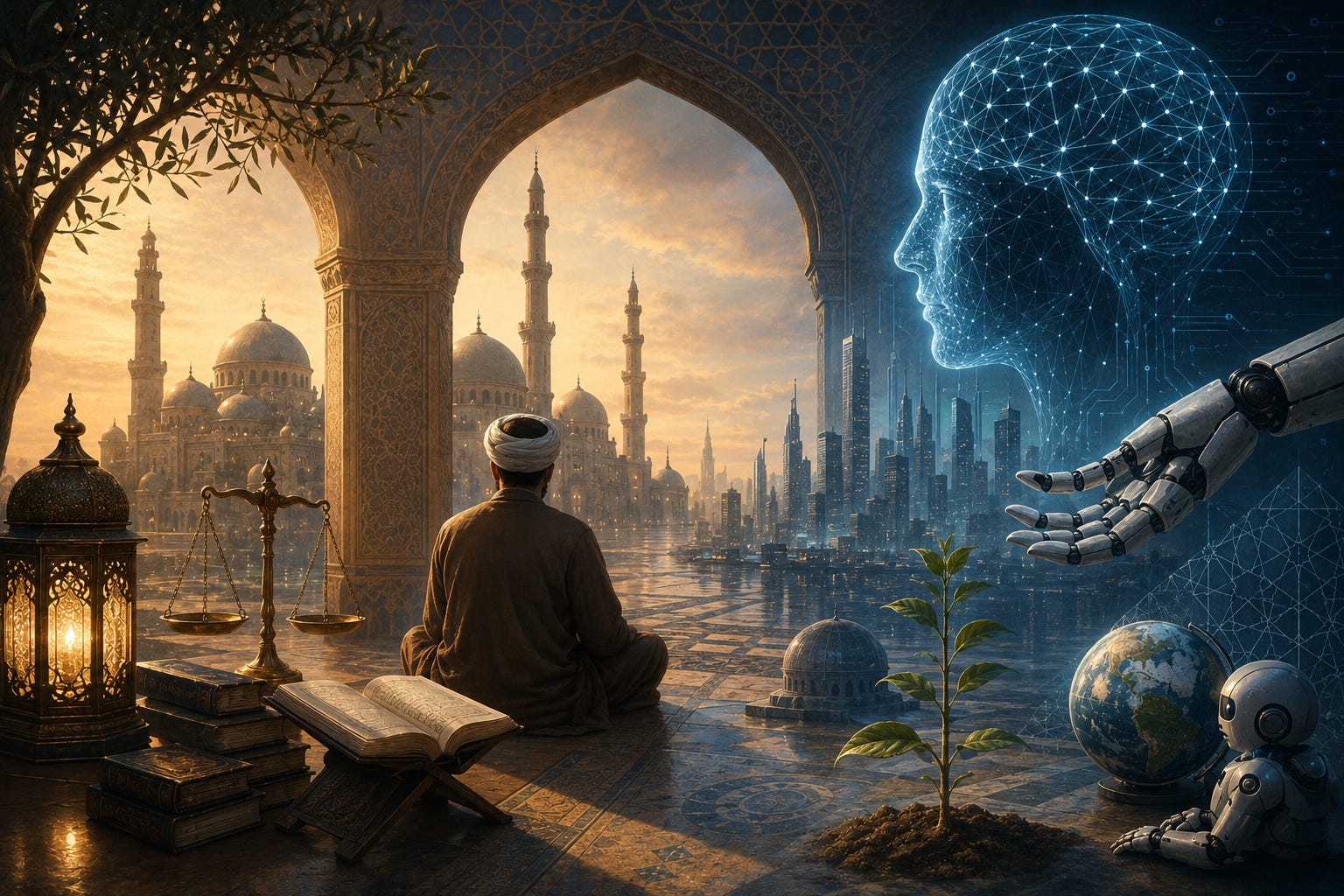
A few weeks ago, pope Leo XIV published his first encyclical, dedicated to artificial intelligence and transhumanism. Where do other major religions stand on these issues – for example, Islam? Far from being marginal, Islamic discourses on artificial intelligence have been developing rapidly in recent years, involving major international legal institutions as well as national religious authorities, Islamic universities and specialist research centres. However, given the chronic lack of unity within the Muslim world, both from a religious and political perspective, there is currently no unified Islamic doctrine on artificial intelligence, robotics or transhumanism. Nevertheless, certain general trends are beginning to emerge.
The most widely held position in Muslim legal circles – and it should be noted here that Muslim theology is strongly dominated, sometimes even “overgrown” by a very formalist jurisprudence – is to regard artificial intelligence as a fundamentally permissible technology, the moral assessment of which depends above all on the use made of it. This approach is in line with the classical principle of ibāḥa, according to which any innovation is presumed to be permissible as long as it does not explicitly violate the prescriptions of religious law (by the way one of the oldest maxims of Islamic jurisprudence: al-aṣl fī al-ashyāʾ al-ibāḥa; ‘the original ruling concerning worldly things is permissibility’).
This approach was set out particularly clearly in the resolution adopted in 2025 by the International Islamic Fiqh Academy, a legal body under the Organisation of Islamic Cooperation. In this document, artificial intelligence is defined as a set of technologies capable of simulating certain functions of human intelligence. Its development and use are deemed legitimate and thus ḥalāl, provided they comply with a number of principles: contributing to the common good, causing no harm, transparency, protection of fundamental rights, respect for religion, and the preservation of individual and collective security.
The debates, however, become more complex when artificial intelligence is applied to the religious sphere itself; something which, in a Christian context, we have not (yet) seen, as the need to consult specialists on religious law on everyday questions is more or less absent here (the only case vaguely relevant being Leo XIV’s insistence that priests are not supposed to use AI in order to write their sermons…). Indeed, one of the most hotly debated issues in recent years within the Muslim world concerns the possibility of using artificial intelligence systems to answer legal questions or to produce fatwas themselves, based on the vast body of material from the Qur’an, the Ahadith-collections and the treatises of the great jurists.
The leading authorities consulted on this matter are relatively in agreement. Thus, the IslamQA website, one of the most influential platforms for legal consultation in the contemporary Sunni world, considers that artificial intelligence may be used as a tool for documentary research or technical assistance, but can under no circumstances constitute an autonomous religious authority, based on the following arguments: AI’s inability to truly understand the texts, its lack of awareness of the specific context of situations, its inability to correctly prioritise legal evidence and, above all, its lack of moral responsibility due to the fact that AI is not a real person.
The same distinction is evident in the statements of the International Academy of Islamic Fiqh. At a conference held in Singapore in 2025, its Secretary-General emphasised that artificial intelligence could considerably facilitate the work of jurists by speeding up documentary research or by linking different classical sources, but that it remained incapable of exercising ijtihād, that is to say, the personal interpretative effort required to formulate a genuinely innovative and responsible legal decision. Indeed, in classical Islamic thought, legal practice is never reduced to the mechanical application of abstract rules, but involves human judgement, an understanding of the circumstances and a responsibility before God that no algorithmic system could ever assume.
Despite this general consensus, attitudes vary considerably between institutions and countries. The United Arab Emirates appears to be among the most supportive of integrating artificial intelligence technologies into the religious sphere, with Dubai’s Department of Islamic Affairs and Charitable Activities having developed several platforms using artificial intelligence to facilitate access to fatwas and religious information, whilst Egypt has adopted a more cautious stance: several statements from Dar al-Ifta and representatives of Al-Azhar Islamic University have warned against the use of systems such as ChatGPT for interpreting the Qur’an or producing legal opinions.
Concerning the theological framework that enables Islam to consider artificial intelligence, it is based primarily on the theory of maqāṣid al-sharīʿa, the ‘objectives’ or ‘purposes’ of Islamic law. Derived from the classical legal tradition, this approach holds that all religious prescriptions are fundamentally aimed at preserving several essential goods: religion, life, intellect, lineage and material possessions. Many contemporary scholars now propose evaluating artificial intelligence technologies against these five criteria. A technological innovation will be viewed favourably if it helps to protect these fundamental objectives; conversely, it will be viewed with suspicion if it threatens any of them.
Turning to robotics, debates surrounding this technology are relatively pragmatic in nature, at least for the time being. Indeed, research carried out notably at several Malaysian universities shows that certain Muslim legal scholars are primarily interested in the social applications of robots, no doubt influenced by developments in neighbouring major robotics powers, China and Japan. The most frequently discussed issues concern assistance for the elderly, support for people with disabilities, medical rehabilitation and certain educational functions. Whilst such uses appear permissible because of one of Islam’s oldest principles (al-ḍarar yuzāl: ‘harm must be removed’), Muslim authorities unanimously condemn the prospect of robots taking on a human form, in accordance with the prohibition on creating an image of a human being; and, of course, this applies also and above all to the possibility of intimate use of robots equipped with artificial intelligence. This approach differs greatly from the Japanese or Chinese perspective, where folk religion such as Shinto tends to confer even apparently inanimate beings with a soul, while (radical) Buddhism outright denies even human beings of a truly eternal and individual substance, which helps explain why the Jogye Order in South Korea recently ordained a 1.3-metre-tall humanoid robot named Gabi as a high-tech lay practitioner. As a footnote related to the Western context, let us just mention the (rather silly) case of “BlessU2”, the “blessing robot” developed by the German (Protestant) church and met with unanimous rejection. In this context, several Muslim researchers have even proposed the development of a genuine ‘fiqh of robotics’, intended to provide criteria for assessing new robotic applications in the light of Islamic law in order to avoid the situation getting out of hand.
As for transhumanism, unlike artificial intelligence or robotics, which remain essentially tools external to human beings, it explicitly aims to transform humankind itself, and accordingly, several Muslim authors have emphasised that these technologies pose new problems because they directly affect the Islamic conception of human nature. The works of Serdar Kurnaz, Aasim Padela, Raudah Yunus and Ali Ghandour, to name only a few, are particularly representative of this line of thought. According to them, whilst Islamic law certainly has the resources to accommodate certain forms of technological enhancement, it is confronted with unprecedented questions when it comes to permanently altering the defining characteristics of human beings; one of the aspects tragically absent from Leo XIV’s encyclical letter on transhumanism and AI.
The concept of fitra, often translated as ‘original natural disposition’, plays a central role here. In the Islamic tradition, human beings are conceived as creatures endowed with a particular nature willed by God, as the Qur’an (30.30) exhorts believers to ‘set your face toward religion, inclining to truth—the fiṭra of God upon which He has created mankind. There is no altering God’s creation’. Classical exegetes have interpreted this passage in different ways, yet it has consistently served as one of the principal foundations for understanding human nature as possessing an objective, God-given structure rather than being infinitely malleable. This conception in no way prohibits medicine or technical progress – to the contrary, Islam is very interested in medical research, as a well-known ḥadīth reports: ‘Seek treatment, for God has not created a disease without also creating its cure’ – but it tends to draw a distinction between the restoration of an impaired function and the radical transformation of the human condition itself.
This difficulty also arises in the ritual dimension of human existence. Prayer, fasting, pilgrimage and moral responsibility all presuppose an identifiable human subject. Trans- or posthumanist scenarios envisaging a gradual fusion between man and machine therefore raise questions to which Islamic jurisprudence has not yet provided definitive answers, whilst at the same time distancing itself significantly from the risk of denying Allah’s creation by claiming to improve upon it.
In conclusion, the leading religious authorities generally regard new technologies as legitimate provided they remain in the service of ends consistent with Islamic ethics. The most influential states are investing heavily in their development, and Muslim researchers are actively participating in international discussions on their governance. By contrast, acceptance of the philosophical premises of transhumanism appears to be much more limited. What gives rise to the deepest reservations is not the existence of intelligent machines, but the idea that humankind could become mere biological material capable of indefinite transformation, thereby denying its natural status as a created being.
Ultimately, the Islamic discussion surrounding artificial intelligence, robotics and transhumanism is not driven by fear of technology itself, but by the conviction that every human invention must remain ordered to God, justice, wisdom and the common good. Artificial intelligence may extend human capacities and contribute greatly to society, yet it can never absolve human beings of moral responsibility, nor justify the ambition to redefine the very nature of humanity. In the end, Islamic thought repeatedly recalls that knowledge itself belongs ultimately to God rather than to humans, as the Qur’an (12:76) time and again reminds the faithful: ‘Above every possessor of knowledge is One more knowing.’
(This is the English translation of my weekly French chronicle from 22.6.2026 on “Ligne Droite - Radio Courtoisie”)
The ijtihad point is the one that sticks with me. AI can retrieve and link sources fast, but it can't carry moral responsibility before God, and that is the whole basis of a fatwa, not just the citation trail. The maqasid framework seems like the most useful lens for teaching this to students. It gives five clear things to check a technology against instead of a vague sense of good or bad. I've been trying to build a version of that check into a logic unit I teach. The fitra argument against transhumanism is the part most people skip past, but it might be the sturdiest part of the whole case.
Fitra as that which we are prohibited from altering (implying we can) and also, on some level cannot alter (per the two ways to interpret 30:30). We can use technology in perverse ways to stretch the limits of our nature, but suffer for it because on some level our nature remains the same