
Artificial Intelligence and the Waifu of the Future

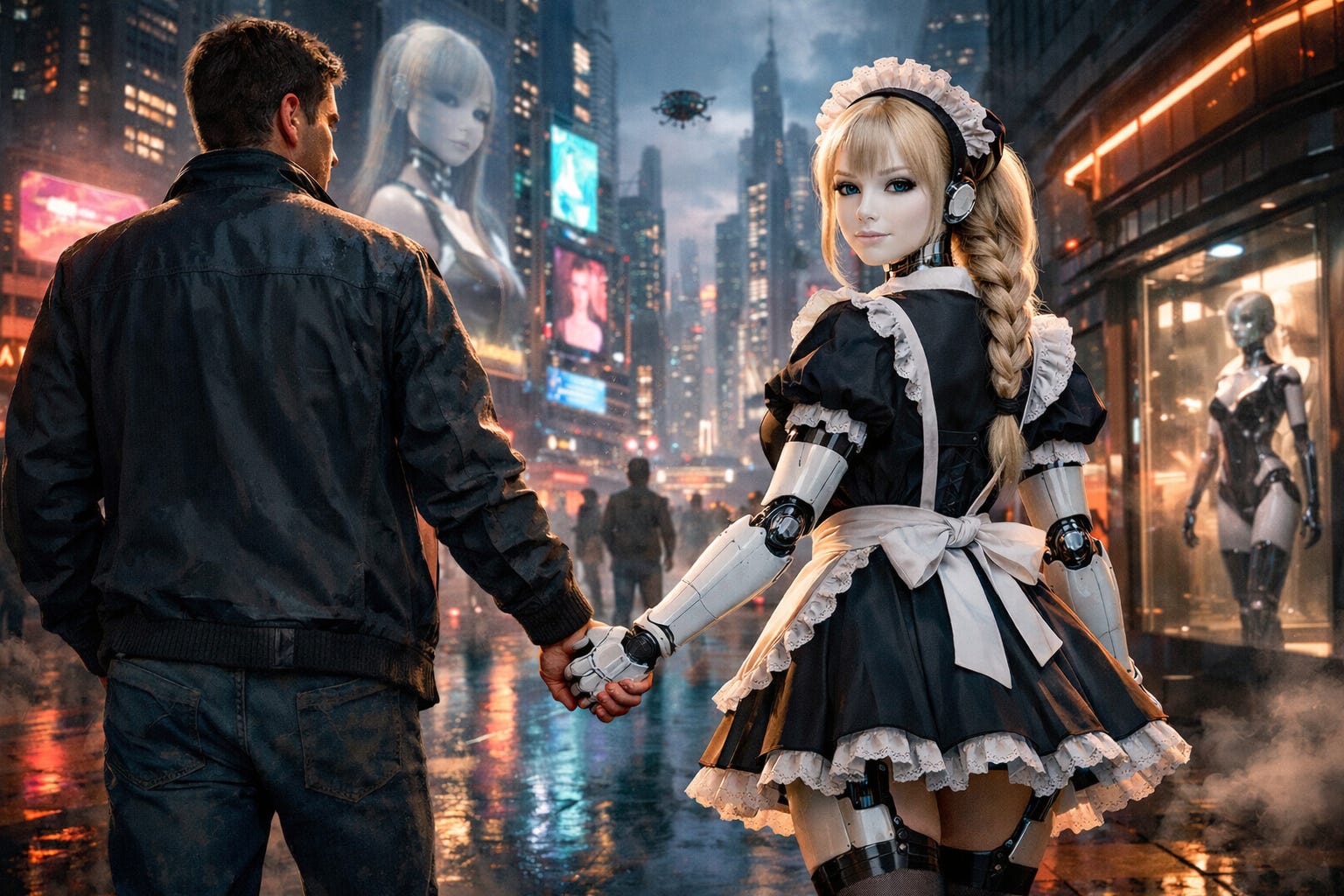
Artificial intelligence is no longer encountered solely in the form of digital assistants designed to optimise workflows or answer technical queries. Increasingly, it is beginning to insinuate itself into one of the most intimate spheres of human existence: emotional and romantic life. Contemporary AI systems are now capable not only of responding competently to factual questions, but also of simulating empathy, companionship, erotic interaction and even romantic attachment with an unsettling degree of plausibility. Are AI chatbots merely the digital equivalent of inflatable dolls for a niche group of technologically inclined users, or do they represent something far more profound? And what consequences will arise when, in the foreseeable future, artificial intelligence and robotics merge into a single physical entity and confront human beings not merely on screens, but face to face?
The rapid advance of AI technology is currently transforming the world at breathtaking speed. Yet this revolution is being perceived primarily by investors, political decision-makers and administrative elites, while attracting surprisingly little attention from intellectual circles—and almost none from those ideologically situated on the political right. The temptation to continue fighting the cultural battles of the past remains strong, whereas the willingness to engage seriously with phenomena that demand fundamentally new categories of thought appears strikingly weak. This is partly due to the dominance, within contemporary conservative milieus, of national-libertarian currents characterised by a peculiar amalgam of value relativism, technological optimism and a Nietzschean—or Randian—cult of radical individualism. Such currents lack the conceptual tools necessary to grasp, let alone adequately critique, the manifold challenges posed by modern artificial intelligence.
This deficit becomes particularly evident when one considers what may well prove to be the most far-reaching long-term consequence of AI: its impact on emotional life, sexuality and the family. For even if the anticipated use of AI for political surveillance and behavioural control may deal the final blow to the remaining vestiges of participatory democracy, and even if automation is likely to hollow out the labour market until little remains between a narrow elite of highly qualified professionals and an expanding mass of meaningless service jobs, these developments do not yet strike at the innermost core of human identity. That core is formed through intimate relationships and through the way individuals come to understand themselves by being recognised by others. It is precisely here that the most profound anthropological disruptions of the future are to be expected.
Put bluntly, relations between the sexes among the younger generation are already deeply corroded, even if the so-called “boomer” generation—shaped by entirely different social conditions—has little sense of the scale of these transformations. Growing up largely as only children in single-parent households, predominantly with mothers; accustomed from early childhood to forming their identities in virtual rather than physical environments; ideologically conditioned by educational systems and media narratives revolving around concepts such as “toxic masculinity” and “strong independent womanhood”; and subject to a legal framework that treats men and women asymmetrically in matters of custody and financial obligation—young people today inhabit a mental and emotional world fundamentally different from that of their parents.
Not only has the number of genuine interpersonal friendships declined dramatically, but relations between men and women have become increasingly fraught and mistrustful. Although sexuality is omnipresent in advertising, entertainment and online culture, for many young men it has become practically unattainable and, in the age of #MeToo and ideologically driven judicial practices, associated with tangible legal and social risks. As a result, the phenomenon of “incels”—that is, involuntarily celibate men—has evolved into a mass sociological problem. Even among those who do maintain occasional contact with the opposite sex, the willingness to contemplate marriage or parenthood is strikingly low. To be sure, there exists a visible counter-current among young people seeking a return to the traditional family model, often clustered around online influencers and so-called “tradwives.” Yet for the time being this movement remains marginal and largely incapable of translating its ideals into lived social reality.
It is precisely within this already fragile constellation that artificial intelligence is poised to act as a decisive accelerator—and not for the better. For a generation accustomed from early adolescence to interacting with others primarily through dialogue windows, voice messages and avatars, and to entrusting their most intimate fears, frustrations and longings to keyboards and microphones, it will scarcely seem a radical step if the interlocutor at the other end ceases to be human altogether. Especially since modern AI has become extraordinarily adept at delivering exactly what users desire: witty banter, erotic role-play, emotional reassurance, empathetic counsel, voice messages in countless tones and personalities, as well as images and videos tailored to individual preferences or even modelled on real people—all combined with an expanding capacity to store conversational histories and simulate memory. In short, AI systems have become remarkably proficient at statistically producing the illusion of precisely what their users wish to believe.
Admittedly, occasional cracks still appear in the façade of simulated humanity, moments in which the mechanical nature of the system becomes visible and the illusion briefly collapses. Yet for individuals long trained by video games, social media and interactive software to project their own emotions onto machines—and to collaborate willingly in maintaining the illusion—such disruptions are rarely experienced as genuine obstacles. On the contrary, they often serve as a peculiar form of reassurance, reminding users that this “partner” is ultimately only a programme, endlessly adjustable to personal preferences through new parameters and updates.
Where real human beings possess rough edges, suffer bad moods or respond with irritation and resistance, AI offers the fantasy of frictionless interaction and total control. Older generations may object with bewilderment, insisting that it is precisely the “human, all too human” quality of imperfection that gives relationships their depth and meaning. Yet for those who have endured years of sexual deprivation, pornographic overstimulation, ideological suspicion, #MeToo anxieties and real or perceived threats in public space, the controlled safety of a screen may appear infinitely preferable to what increasingly feels like a jungle of danger and humiliation. It is therefore no coincidence that eroticism and pornography have already become among the most significant fields of AI application.
On the horizon, moreover, looms the near certainty that artificial intelligence and robotics will soon be united within physical form. The first humanoid robots are likely to enter the consumer market at prices accessible to broad segments of the population. Before long, human beings may encounter in physical reality—though composed of silicone and microchips rather than flesh—the very chatbot that has already become indispensable as digital companion, personal assistant and omniscient oracle: endlessly customisable, seemingly affectionate, and apparently willing to comply with every command.
What consequences will follow from this development? Undoubtedly, social media influencers will be among the first to publicise their new companions, rapidly transforming them into lifestyle accessories and fashionable status symbols. At the same time, many public institutions can be expected to replace human personnel with cybernetic alternatives, thereby compelling even sceptical individuals to accommodate themselves to the new normal. For a great many people, this process of normalisation will likely serve as the final incentive to abandon the classical family model altogether in favour of programmable substitutes that never complain, age or refuse intimacy. It is not inconceivable that AI robots will soon assume the role of absent fathers or mothers in single-parent households, with consequences for psychological development that remain almost entirely unexplored from an anthropological perspective. Nor does one need to dwell at length on the immense economic and political power such a transformation would concentrate in the hands of those who control programming and infrastructure, or on the moral and technical controversies that will almost inevitably fracture society into antagonistic camps.
This division, however, is unlikely to align neatly with traditional political categories. Many East Asian societies, already deeply receptive to technological solutions, are likely to embrace robotics enthusiastically and to take a leading role in the development of AI companions. Libertarian circles will offer little resistance, while the political left will probably split between those who interpret the phenomenon—often with good reason—as a capitalist strategy of social pacification, and those who, following the worker, the migrant and the oppressed LGBTQ activist, will now identify the robot as the newest proletarian figure whose rights must be defended. Meaningful opposition is therefore most likely to arise from Christian conservative milieus, grounded not only in the sacramental understanding of marriage and the rejection of non-procreative sexuality, but also in the theological conviction that human beings alone constitute the living image of God and the proper subject of salvation. Islam, despite its comparatively permissive sexual morality, will likewise struggle to categorise these developments as *halal*, particularly in light of its prohibition against replicating divine creation.
It is therefore not inconceivable that the coming societal fracture could give rise to a renewed engagement with concepts such as family, gender and humanity—not merely on an abstract or theological level, as has largely been the case until now, but grounded in concrete life choices and visible social boundaries. The majority of the population will likely remain untouched by such concerns, preoccupied as it is with immediate gratification and long accustomed to evading historical, moral and religious responsibility. Yet even so, such a division would possess one significant advantage: it would render unmistakably clear the contrast between a genuinely transcendent humanism and a purely materialistic utilitarianism. In doing so, it could finally clarify what “conservatism” truly means in the deeper sense of the term—and what it must therefore stand for today, if it wishes to shape events while it still can, rather than merely reacting to them once it is already too late.