
しょうがない
Is Japan Sinking?

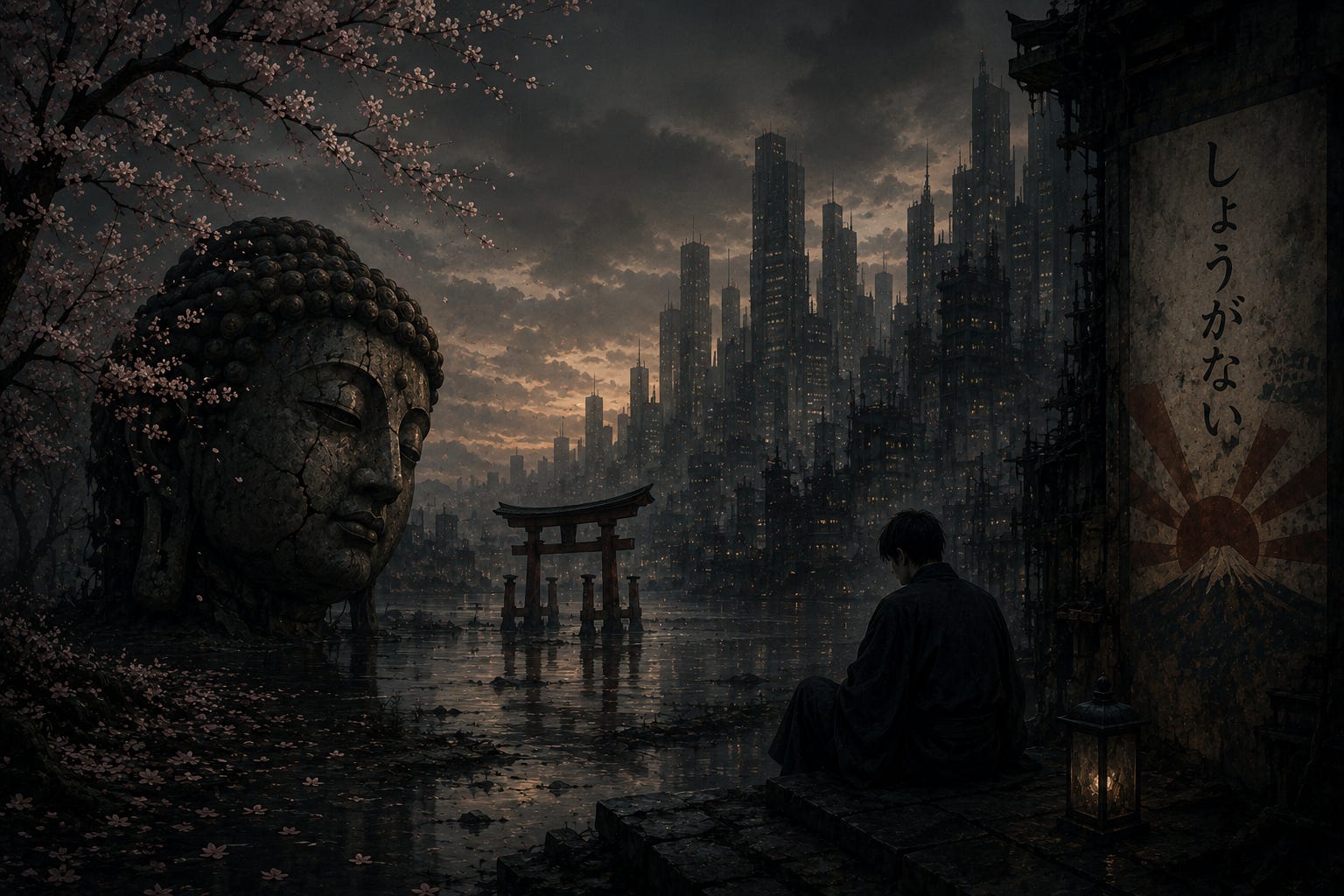
A good friend has just lent me Sakyo Komatsu’s famous dystopian novel “The Sinking of Japan”, and reading it has taken me back to the world of my youth, when Japan still represented one of the great promises of the modern world. In the 1970s, and even more so in the 1980s, it embodied industrial success, technological modernity and a form of disciplined capitalism that many, in Europe as well as in the United States, considered superior to the traditional Western model. Japanese cars were taking the world by storm, Sony was transforming consumer electronics, Toyota was revolutionising production methods, whilst Tokyo seemed to be heralding the 21st century ahead of everyone else: some American essayists even spoke of a ‘Japanese century’.
Then Japan slowly faded from the centre of the global narrative. Of course, the country remains omnipresent in our cultural daily lives: manga, anime, video games, gastronomy and minimalist design continue to exert a global fascination. But this pervasive influence masks a deeper fading, for European strategic debates now revolve around the United States, China, Russia or India, and even South Korea sometimes seems to occupy more of the Asian media spotlight than Japan. The “Empire of the Rising Sun” seems to have withdrawn from history, though not through nuclear catastrophes, Godzilla attacks, geological cataclysms or tsunamis, but gradually, almost imperceptibly.
Indeed, the “Sinking of Japan” did not happen overnight. As early as the 1990s, the writer Yoshimoto Takaaki described a society that had entered a phase of “low historical intensity”, characterised by both solid material prosperity and endemic stagnation, in stark contrast to the era of grand collective projects. Admittedly, today Japan still holds the more than honourable position of the world’s fourth-largest economy and is one of the most politically stable countries on the planet. But it now seems primarily concerned with managing its demographic and economic decline as effectively as possible, thus becoming, after having embodied the future, the first major developed society organised around the management of decline.
*
During the 1960s, annual growth averaged around 10 per cent; in the 1980s, it was still around 4 per cent; since 1992, however, it has mainly fluctuated between 0 and 1 per cent. At least from the outside, the great shift therefore began with the bursting of the financial and property bubble in the early 1990s, and the famous “lost decades” then became the symbol of lasting stagnation: weak growth, near-zero inflation, accelerated ageing, and anxiety over the rise of China. Now, Japan’s share of global GDP has fallen from around 18% in 1995 to around 4% today; yet the very word “stagnation” is somewhat misleading given the negative connotations it often carries. Seen from Europe, Japan still appears not only extremely stable but also extraordinarily sophisticated, as we know, and the country still dominates key industrial sectors: robotics, electronic components, fine chemicals, machine tools and advanced materials. But the days when Japan led the way in the technological world of the future seem well and truly over.
The civilisational exhaustion so often observed is, moreover, not merely economic, but also cultural. The Japan of past decades had developed an almost oppressive work ethic, embodied by armies of salarymen entirely devoted to the company. Today, a significant proportion of young people are taking the opposite path: faced with professional pressures deemed inhuman, more and more young people are instead choosing a minimal, reclusive existence for which the psychiatrist Tamaki Saitō popularised the term hikikomori—that is, individuals withdrawn from the social world, taking refuge in virtual worlds rather than in political action or collective utopias, and avoiding professional ambitions as well as the founding of proper families.
Admittedly, some years ago, Shinzo Abe attempted to restore at least some strategic ambition to the country’s foreign policy, and his doctrine of a ‘free and open Indo-Pacific’ aimed to contain China’s rise and restore a more assertive geopolitical role. But even this attempt remained cautious and largely fruitless. As the political scientist Masaru Tamamoto notes, Japanese society now prefers stability and introspection to strategic heroism, for power is no longer seen as a promise, but as a risk. Even the famous Yukio Mishima, one of the heroes of the European New Right, denounced, before his spectacular suicide in 1970, a Japan that had become materialistic, pacifist and Americanised, having abandoned any heroic dimension in favour of economic prosperity alone, and this transformation seems today, when even the work ethic is disappearing, largely complete.
In a sense, Japan is thus returning to a more traditional phase of its long history. For centuries, the archipelago had lived within the Chinese cultural sphere, as writing, Buddhism, legislation, Confucianism, art, technology and administrative organisation all originated on the mainland. Only the Meiji era and the imperialist expansion of the 20th century brought about a historic rupture, when Japan chose the West over China and sought to dominate the very culture to which it owed a large part of its own civilisation. The return of Chinese power is now reintroducing a regional asymmetry that many Japanese regard as, admittedly, regrettable, but ultimately historically natural.
Japan’s great trauma, however, is neither economic nor diplomatic, but demographic. Since the 1990s, Japan has become the world’s laboratory for ageing and is experiencing before others what a post-growth society is like, where the main problem is no longer the production of wealth, but the maintenance of social balance. The fertility rate has plummeted to around 1.2 children per woman; the population has fallen from 128 million in 2008 to around 123 million today; the median age is now around fifty; and nearly 30% of the population is over sixty-five. What is most striking for a European is that Japan nevertheless refuses to respond to this crisis through mass immigration; a refusal that is not only political, but above all civilisational, and justified both by the historical memory of Japan’s voluntary isolation under the Tokugawa shogunate and by the advantages of the immense cultural homogeneity that the island nation has always enjoyed and to which it clings with surprising tenacity. Japan has therefore chosen a different path: automation. Industrial robotics, technological assistance for the elderly, the ubiquity of artificial intelligence — everywhere, the country is attempting to compensate for the shortage of human beings through technology, giving rise to what the philosopher Hiroki Azuma regarded as a “gentle post-human” society, where technology no longer serves to conquer the world but to compensate for the gradual disappearance of traditional social bonds. But even in this field, Japan no longer appears to be the absolute vanguard, as China has already overtaken the archipelago in virtually all strategic sectors of future technologies.
The shift in the Japan-China dynamic is now affecting culture itself. During the 1990s and 2000s, Japan had captured the global imagination; Pokémon, Dragon Ball, Studio Ghibli and Final Fantasy formed a sort of global cultural empire characterised by a fusion of popular culture and the avant-garde that Takashi Murakami had termed the “superflat” society. Admittedly, behind this aesthetic often lay a deep nostalgia, particularly evident in Hayao Miyazaki’s bucolic rural villages, his animist spirituality, his wariness of industrialisation, and his quest for a lost harmony between technology and nature; yet this melancholy was tempered by a perhaps naïve, yet endearing and eminently fascinating faith in an ultra-technological future. Today, Japan’s cultural influence remains, admittedly, immense, but it no longer defines our era, whereas, conversely, China is gradually building a comprehensive cultural ecosystem based more on platforms than on content, as TikTok demonstrates; and we can safely bet that China will also very soon catch up in terms of “soft power”.
*
Seen from Europe, this lack of dynamism, this excessive caution and this low confidence in the future may seem worrying, and ultimately, it is perhaps precisely for this reason that Japan fascinates us less today: because it is becoming more and more like us and reflects back to us a reality we refuse to accept and choices we are not (yet) ready to face. A society that is wealthy yet ageing, technologically advanced yet hesitant, strategically dependent on the United States whilst living in the shadow of a rising China, banking on post-humanism rather than demographics, and having replaced collective ambitions with an almost post-historical introspection based on the old Japanese principle of shōganai (“ there’s nothing to be done about it”), which does not exactly mean resignation, but rather the pragmatic acceptance of realities deemed inevitable – does all this not bear a striking resemblance to Europe, minus the “Great Replacement” and the explosion of crime? It is hardly surprising that some recall the analyses of Oswald Spengler who, as long as a century ago, in his “Decline of the West”, described Japan as one of the few civilisations capable of assimilating European technological and organisational forms – and thus at risk of replicating our own decline in an equally accelerated form.
This ultimately raises two questions that are rarely asked. Firstly, why does Europe speak so little of Japan as a major strategic partner? Uncertainty over American commitment and industrial dependence on China should logically push Europeans and the Japanese to draw closer together, and yet this partnership remains surprisingly low-key. Secondly: might Japan’s decline foreshadow that of China? Japan was several decades ahead of China in its Westernisation, just as it was in its demographic ageing; yet Beijing is already showing worrying signs of a collapsing birth rate. It is therefore not impossible that China, too, will soon be forced to use all its power less for expansion than for stabilising its own internal balance, and that the “Sinking of Japan” might be followed by the “Fading of China”. But that is already another story.
Recently Japan faces also political driven major immigration from e. i g. Bangladesh, muslims' provocations, burning of temples and farms. Hopefully this will function as a wakeup-call that pure endurance, conformity and retreat is not rewarded by history unfortunately. I hope Japanese will step out of all this NWO-institutions and stay true to themselves again.
Japan is an interesting case because it challenges the idea that endless growth (by GDP) is the only path to success. Maybe In a shrinking and aging society, should the goal be maximum growth or a good life for everyone? In that sense, Japan may be one of the first major countries learning how to live well in a world where population growth and rapid economic expansion are no longer guaranteed.